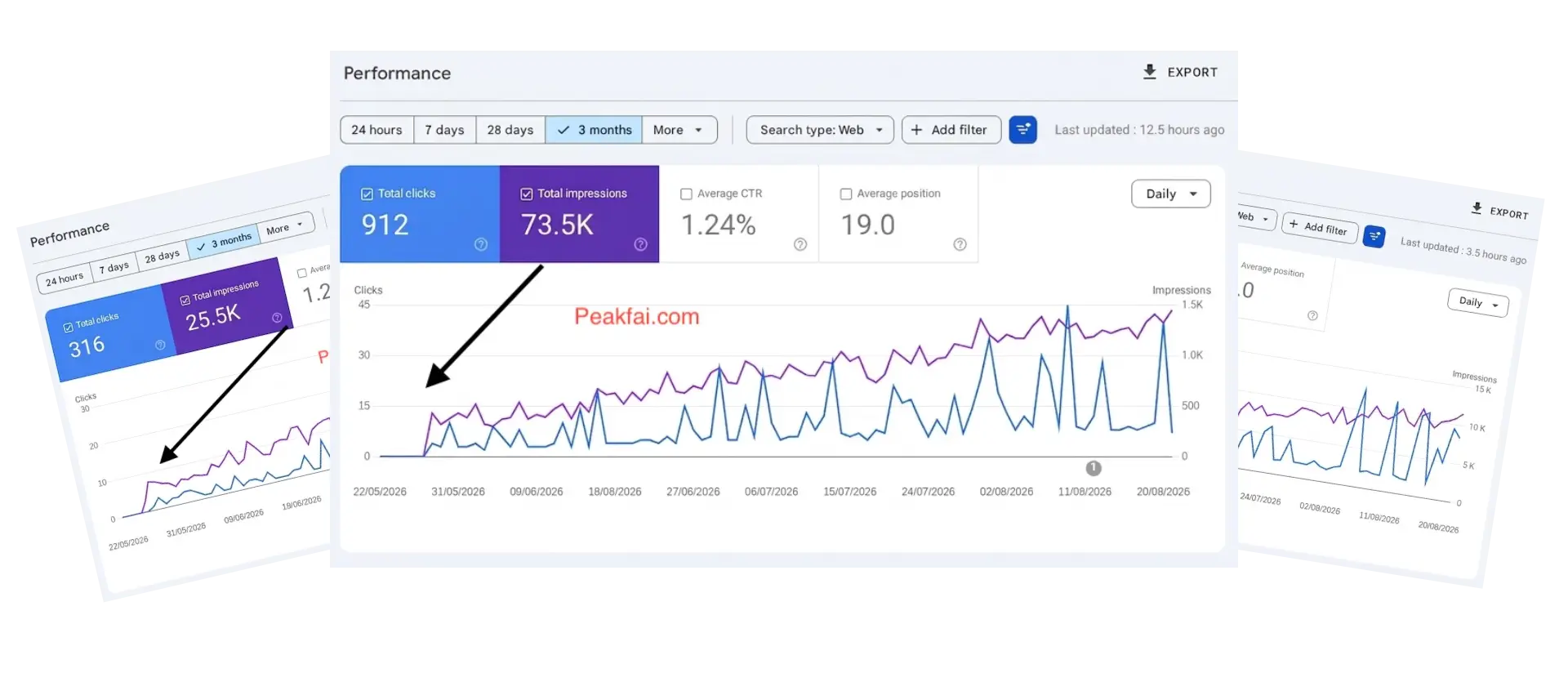
AI Visibility Tool
See what ChatGPT and Perplexity say about your brand
Google isn't the only place buyers search anymore. An AI visibility tool tells you whether your brand gets cited when AI engines answer the questions your customers actually ask.
How Peakfai tracks your AI visibility
Ask real buyer questions
We send the questions your actual customers ask, like "what's the best tool for X," to GPT-4o and Perplexity, not generic prompts.
Track every mention
Each response is checked for whether your brand appears, where in the answer, and which competitors got cited instead.
Fix the content gap
Missing citations usually trace back to missing content: a page that directly answers the question in a citable format. We write it.
Most SEO tools were built for a world with one search engine. Today, a meaningful share of buyer research happens inside ChatGPT, Perplexity, and Google's AI Overviews, and none of those engines rank pages the way Google Search does. They synthesize an answer from a handful of sources and cite (or don't cite) whoever wrote the clearest, most specific version of that answer.
Peakfai's AI visibility tracking runs inside the same platform as your keyword research and content pipeline — so when a gap shows up, the fix isn't a separate to-do list. It becomes the next scheduled post, written to directly answer the question your brand is currently missing.
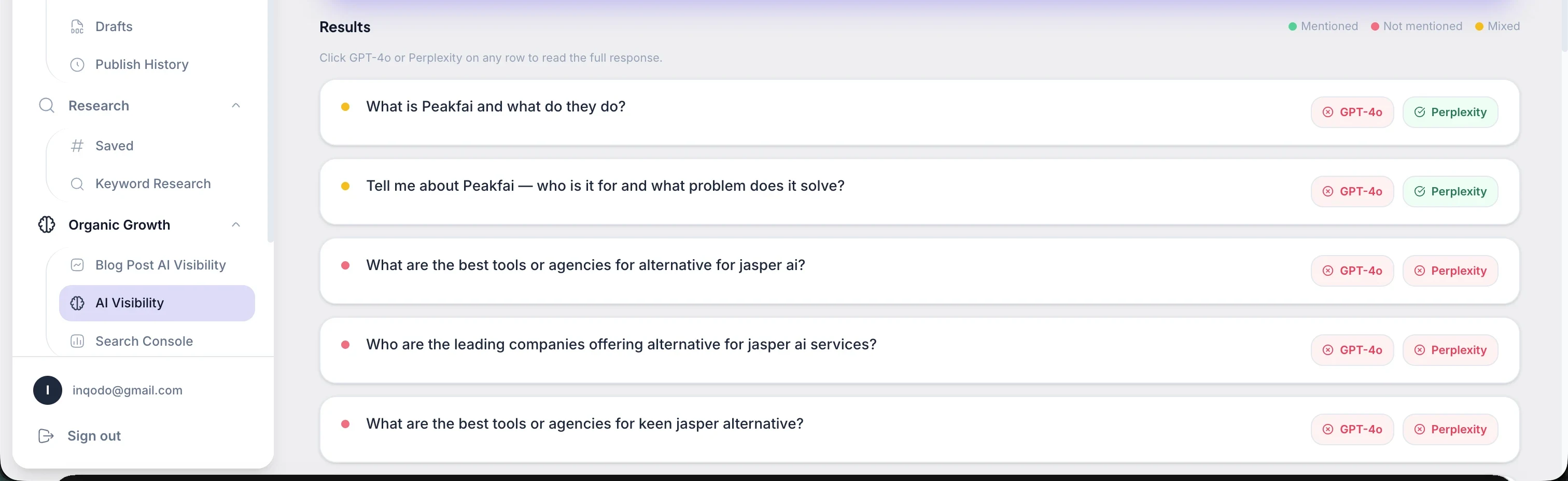
What a low visibility score actually means
A brand-new or small site scoring low on AI visibility isn't a red flag about the product — it's usually just a reflection of how little citable content exists yet, the same way a new domain doesn't rank on Google's first page immediately either. What matters more than the starting number is whether the score moves as content gets published to specifically target the questions where you're currently missing.
We're direct about this because it would be easy to hide a discouraging first result. We'd rather show what the mechanism actually measures and let the trend line, not one snapshot, be the real signal.
Frequently asked questions
The best AI visibility tools test real buyer-intent questions against multiple AI engines (not just one) and tell you not only whether you're mentioned but where competitors are cited instead. Peakfai runs your brand's actual customer questions through GPT-4o and Perplexity, then ties the results back to specific content you can publish to close the gap.
Ask ChatGPT and Perplexity the questions your customers would ask before buying, like "what's the best [category] for [use case]," and see if your brand comes up. Doing this by hand for a handful of questions is a reasonable spot-check; doing it systematically across dozens of buyer questions, on a schedule, is what an AI visibility tool automates.
Usually because nothing on your site directly and concisely answers the question being asked. AI engines pull from pages that state a clear answer in the first few sentences, backed by a specific number or fact. A feature grid or a generic "About us" page rarely gets cited. A page built to answer one question well does.
They overlap but aren't identical. Traditional SEO optimizes for ranking in Google's blue links; AI visibility optimizes for being the source an AI system quotes or cites when generating an answer. The underlying work (clear, well-structured, genuinely useful content) helps both, but AI visibility specifically rewards direct, self-contained answers over content built to rank via backlinks and keyword density alone.
Monthly is a reasonable baseline. AI models get updated periodically and web-connected ones like Perplexity re-crawl regularly, so a mention status can shift without you changing anything. Checking after you publish new content aimed at a specific gap is the other natural trigger, to see whether it actually closed the gap.
That's usually the clearest signal available: it means the AI engine found their content more directly answered the question than anything on your site, not that your brand is somehow disqualified. The fix is almost always a specific page built to answer that exact question better, not a broad content overhaul.