AI SEO Tools
AI SEO tools that research, write, publish, and track — in one place
Most 'AI SEO tools' only handle one step. Here's what the category actually covers, and where a single connected platform beats stitching four subscriptions together.
“AI SEO tools” is a broad label that covers at least four different jobs: finding keywords worth targeting, writing content for them, optimizing that content for on-page SEO, and publishing it on a schedule. A growing fifth job (tracking whether your brand gets mentioned in ChatGPT and Perplexity answers, not just Google rankings) is what most tools in this category still don't touch.
Below is what each job actually costs as a standalone tool, and what changes when one platform handles all of them together with a human reviewing the strategy.
| Capability | As a standalone tool | With Peakfai |
|---|---|---|
| Keyword research | Ahrefs, Semrush: $99–199/mo | Included, scored by real difficulty + buyer intent |
| AI writing | Jasper, Koala AI: $39–99/mo | Included, written in your brand voice |
| Content briefs & on-page SEO | Surfer SEO: $89/mo | Included, applied automatically |
| WordPress publishing | Manual, or Zapier + plugins | Included, auto-publishes on schedule |
| AI search visibility (AEO) | Rarely covered by SEO tools | Included: tracks ChatGPT & Perplexity citations |
| Human strategy review | Not included at any price | A real SEO manager, every plan |
The real cost of stitching tools together
Add up a typical stack (a keyword tool, an AI writer, an on-page optimizer, a publishing workflow) and the subscriptions alone often run $300-500 a month before anyone has spent an hour connecting them. The bigger cost is usually time: someone still has to export keywords from one tool, paste them into another, review the draft, and manually publish it. None of that work disappears just because each individual step is AI-assisted.
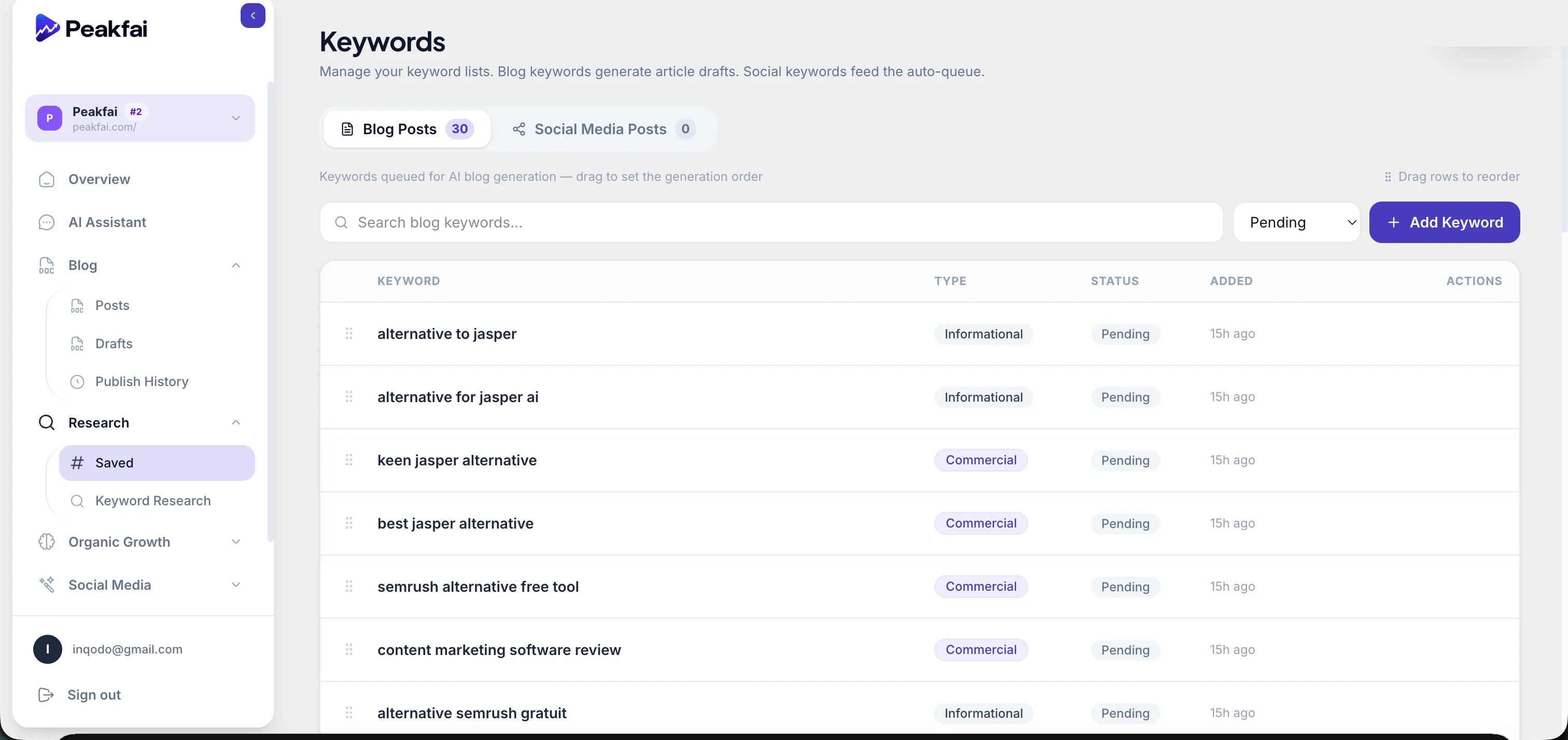
That's the gap a connected pipeline closes — not by being smarter at any one step, but by removing the manual handoffs between steps entirely, so the research a keyword tool produces actually turns into a published post without a person in the middle every time.
When a single platform isn't the right call
If your team already has a mature workflow around a specialized tool (a deep Ahrefs setup with custom reporting, or an editorial process built around a specific writing tool), ripping that out to consolidate isn't automatically worth it. The case for one connected platform is strongest when you're building the pipeline from nothing, not when you're replacing something that already works.
Frequently asked questions
It depends on what part of SEO you need help with. Keyword tools like Ahrefs find search volume, AI writers like Jasper draft text, and optimization tools like Surfer score your drafts. But most businesses end up paying for three or four of these separately and still doing the publishing and strategy by hand. Peakfai is built to cover the full pipeline (research, writing, publishing, and AI-search tracking) in one platform, with a human SEO manager reviewing the strategy rather than leaving it to an algorithm alone.
The ones that just generate generic text on the highest-volume keyword aren't. Google's helpful content guidelines penalize unhelpful content regardless of who wrote it. AI SEO tools are worth it when they're grounded in real competitor data and buyer intent, not just search volume, and when a human still checks the strategy before you spend months publishing against the wrong keywords.
For execution, mostly yes: AI can research keywords and write publish-ready drafts faster than a typical agency retainer. What AI alone can't do is catch a keyword that looks easy but isn't, or tell you when your content plan needs to change as your site gains authority. That's why Peakfai pairs the AI pipeline with a real human SEO manager instead of shipping pure automation.
Not if the tools you're using talk to each other. Most standalone keyword tools hand you a spreadsheet you then have to feed into a separate writing tool by hand. Peakfai's keyword research feeds directly into the writing and publishing pipeline, so the easiest, highest-converting keywords in your list get written and published first automatically.
Ask whether keyword recommendations are scored against your specific site's authority or just show generic search volume, whether a human reviews the strategy or it's fully unsupervised, and whether the tool covers AI-search visibility or only classic Google rankings. Most tools in this category answer no to at least one of those.
Not always. If you already have a strong dedicated tool for one job (an established Ahrefs workflow for research, say) and just need writing and publishing filled in, stitching tools together can still work. The connected-platform approach pays off most when you don't already have that infrastructure and are building the whole pipeline from scratch.